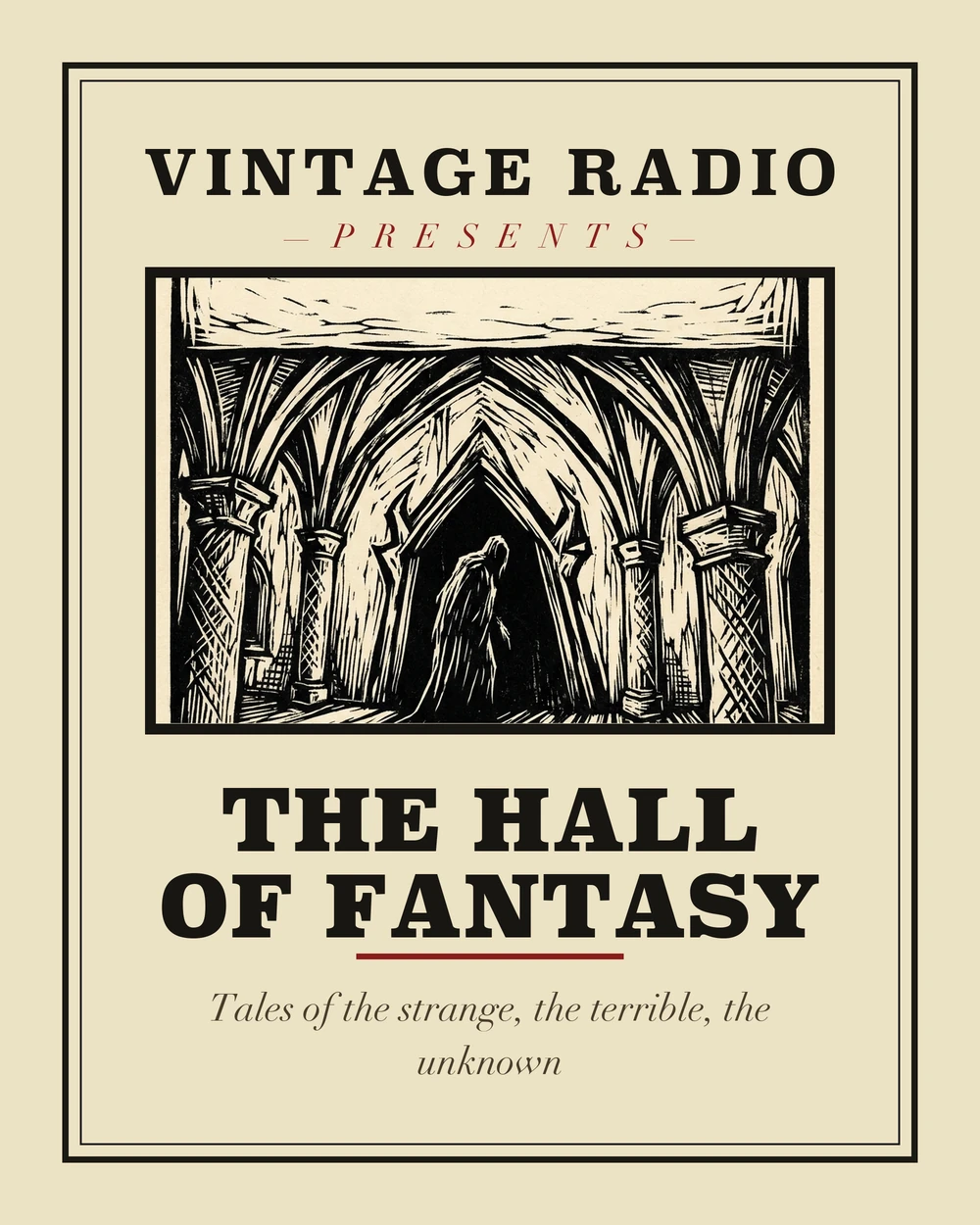
The Hall of Fantasy
Man Against the Unknown — and Man Usually Lost
Most radio horror shows of the early 1950s gave their protagonists a fighting chance. The Hall of Fantasy was less generous. The show's premise was built around man struggling against forces beyond his understanding, and the stories didn't flinch from letting those forces win. Killer fogs, the walking dead, vampires — the supernatural here wasn't a puzzle to be solved or a menace to be defeated. It was dangerous, awesome, sometimes devastating, and always frightening. That willingness to let the darkness take its toll gave the show a harder edge than most of its contemporaries.
Shock endings were a regular feature — the kind where the hero doesn't make it out, where a vampire's teeth sink into a throat and that's simply where the story ends. Surviving recordings show a signature format: a scene from the climax used as a teaser at the very beginning of each episode, so listeners knew from the opening seconds that something terrible was coming, even if they didn't yet know to whom.
From Salt Lake City to the Network
The Hall of Fantasy didn't start on Mutual. It started in 1946 as a local program at KALL in Salt Lake City, where Richard Thorne and Carl Grayson were both station announcers who co-produced the series. Those early scripts were written or adapted by Robert Olson, and they leaned more toward murder mysteries with traditional good-triumphs-over-evil endings than the bleaker horror the show would later become known for. That first Salt Lake run amounted to 26 episodes, sponsored by the Granite Furniture company, before Thorne and Grayson went their separate ways in 1947.
They found themselves working together again in 1949, this time at WGN in Chicago, and revived the series directly. The first WGN episode aired Saturday, December 10, 1949, with an adaptation of Poe's "The Cask of Amontillado," initially in a Saturday afternoon slot. The Chicago run lasted into early 1952 and reached episode 112 before the show stepped up to the Mutual network in August. The WGN production was a clear step up from the Salt Lake originals, with sources describing unusually excellent production values and sound effects that distinguished it from the bare-bones KALL shows. Jim Ameche, brother of Don Ameche, appeared in some of those Chicago episodes.
The Mutual run picked up the internal episode count at 201 and ran on Friday nights at 9:30 through September 26, 1952 — six episodes including "The Brown Plague," "The Shadow People," "Black Book of the Raven," and "The Crimson Hands of Kali." After a brief hiatus the show returned January 5, 1953 on Monday nights at 8:30 and continued through late September of that year.
The Man Behind It
Richard Thorne did almost everything on this show. He created it, wrote it, produced it, directed it, served as principal narrator, and stepped in front of the microphone to play many of the character roles himself. That kind of one-man operation meant the series had a consistent sensibility running all the way through — from the page to the performance. Leroy Olliger and Glenn Ransom also served as directors, and Harold Turner composed and performed the music that gave the show its sonic atmosphere.
About half the scripts were Thorne originals; the rest were adaptations of classic horror and weird fiction. The Mutual run drew on Robert Louis Stevenson's "Markheim," Poe's "The Cask of Amontillado" and "The Tell-Tale Heart," Sheridan Le Fanu's "Green Tea," and M. R. James's "Count Magnus" (aired as "He Who Follows Me" and apparently again as "The Steps That Follow Me" — these may be the same recording with altered credits, which "suggests one, or both, recordings have been doctored for unknown reasons"). Bram Stoker's "The Judge's House" and Edith Nesbit's "Man-Size in Marble" also got adaptations. Thorne's own scripts could be just as memorable: "The Night the Fog Came" involves microscopic aquatic life forms from the marshes of Lake Superior that travel overland in fog and kill everyone they touch, and "The Black Figurine of Death" follows a dying man who vows to return from the grave to take revenge on neglectful family using the title object as his instrument.
A Chicago Cast
The performers who brought these stories to life were drawn from the Chicago radio community. Harry Elders, Eloise Kummer, Carl Grayson, and Maurice Copeland all appeared in the series. Chicago had a deep pool of radio talent at this point in the medium's history, and these performers were experienced enough to handle the range of horror material the show demanded — whether that meant playing the ordinary person who stumbles into something terrible, or the something terrible itself. Thorne's own appearances in character roles meant the ensemble had a fluid quality, with its creator moving in and out of the stories alongside the rest of the cast.
What Survived
Across all four series runs — the 1946–47 KALL shows, the 1949–52 WGN Chicago revival, and the two Mutual stretches — somewhere over 200 episodes were produced. Only about 40 are believed to have survived, with titles catalogued for nearly 150 that are lost. Seventy-two episodes are currently catalogued across surviving holdings, the earliest dating to February 1947. Some of what survives traces back to a 1970s syndication repackaging of the Mutual run, which aired on at least one local public radio station in 1978; reel-to-reel recordings from that broadcast are among the copies that ended up preserved. One lost 1953 episode, "The Jewels of Kali," was reproduced from the script in 1979 because no satisfactory copy of the original had been found — without Thorne, who by then was long out of the radio business. Surviving scripts are held at the Library of Congress.
Thorne — Richard Charles Thorne — died on February 12, 2007, at age 81. After radio he wrote, directed, and produced training films, winning multiple awards; he taught at Columbia College in Chicago and at some point served as press secretary to the governor of Illinois. The Hall of Fantasy was one of three nationally syndicated radio programs he wrote for Mutual. The show has often been described as overlooked even by fans of old-time radio, despite superb acting and unique and dramatic material — a fair description of a series that quietly did some of the most uncompromising horror work radio ever produced, and then mostly vanished.